Affiliate disclosure: Some links on this page are affiliate links. If you purchase through them, we may earn a small commission at no extra cost to you. We only recommend products we genuinely believe in.
Hotel & Room Security
Hotel rooms vary wildly in actual safety — the lock on the door, the CO detector on the ceiling (if there even is one), the peephole anyone can look through from the hall. These items give you control over your own safety regardless of the property's standards.
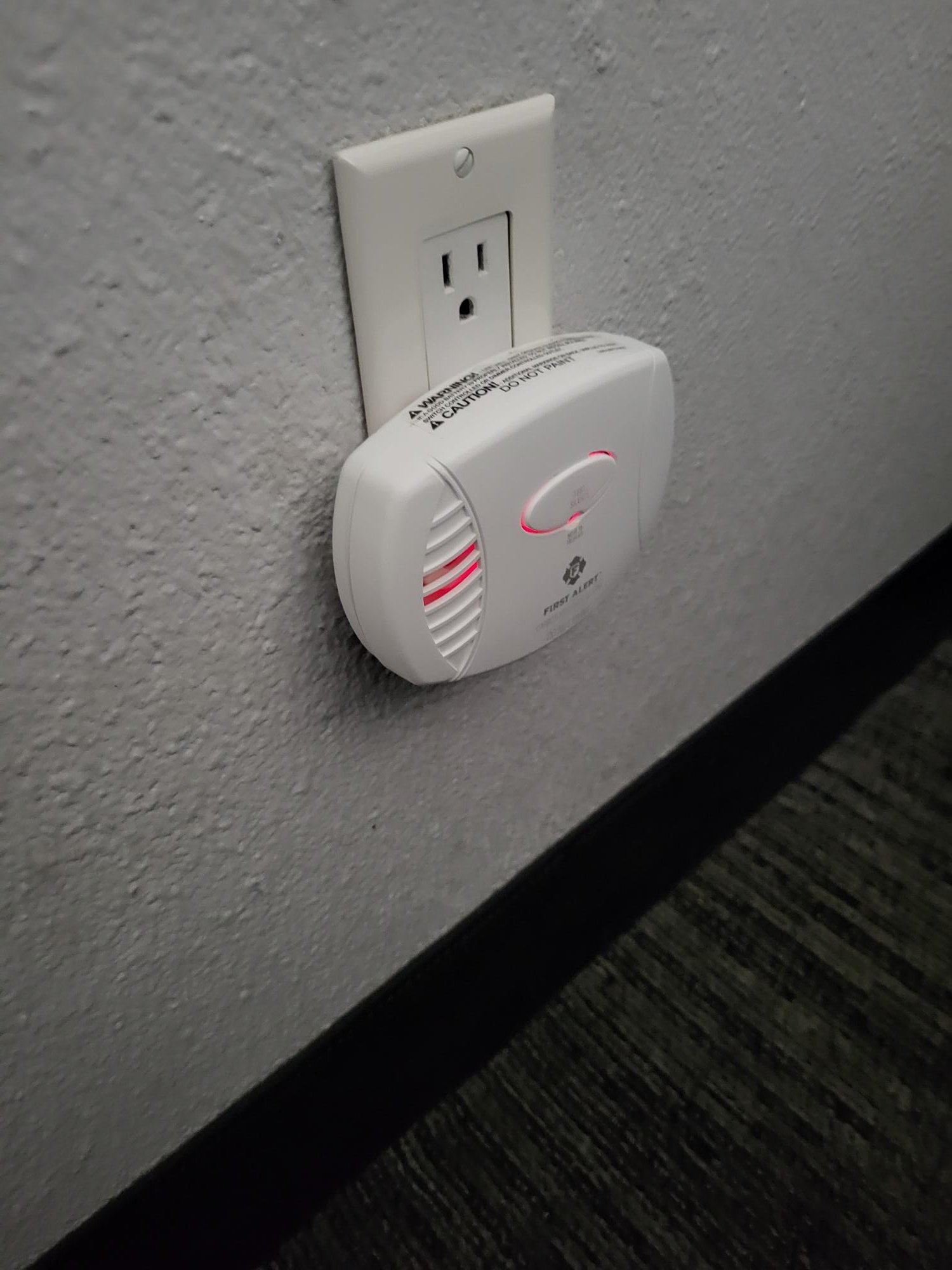
Portable Carbon Monoxide Detector
This is the one item on this list that could literally save your life. Most travelers never think about CO poisoning — but hotels, vacation rentals, and guesthouses worldwide often have aging heating systems, gas appliances, or poor ventilation. CO is odorless and invisible. By the time you feel sick, it may be too late. A palm-sized detector plugs into any outlet and alerts you immediately. The peace of mind alone is worth it.
- Could save your life
- Small and lightweight
- Works worldwide with adapter
- Needs power outlet
- Adds to carry weight
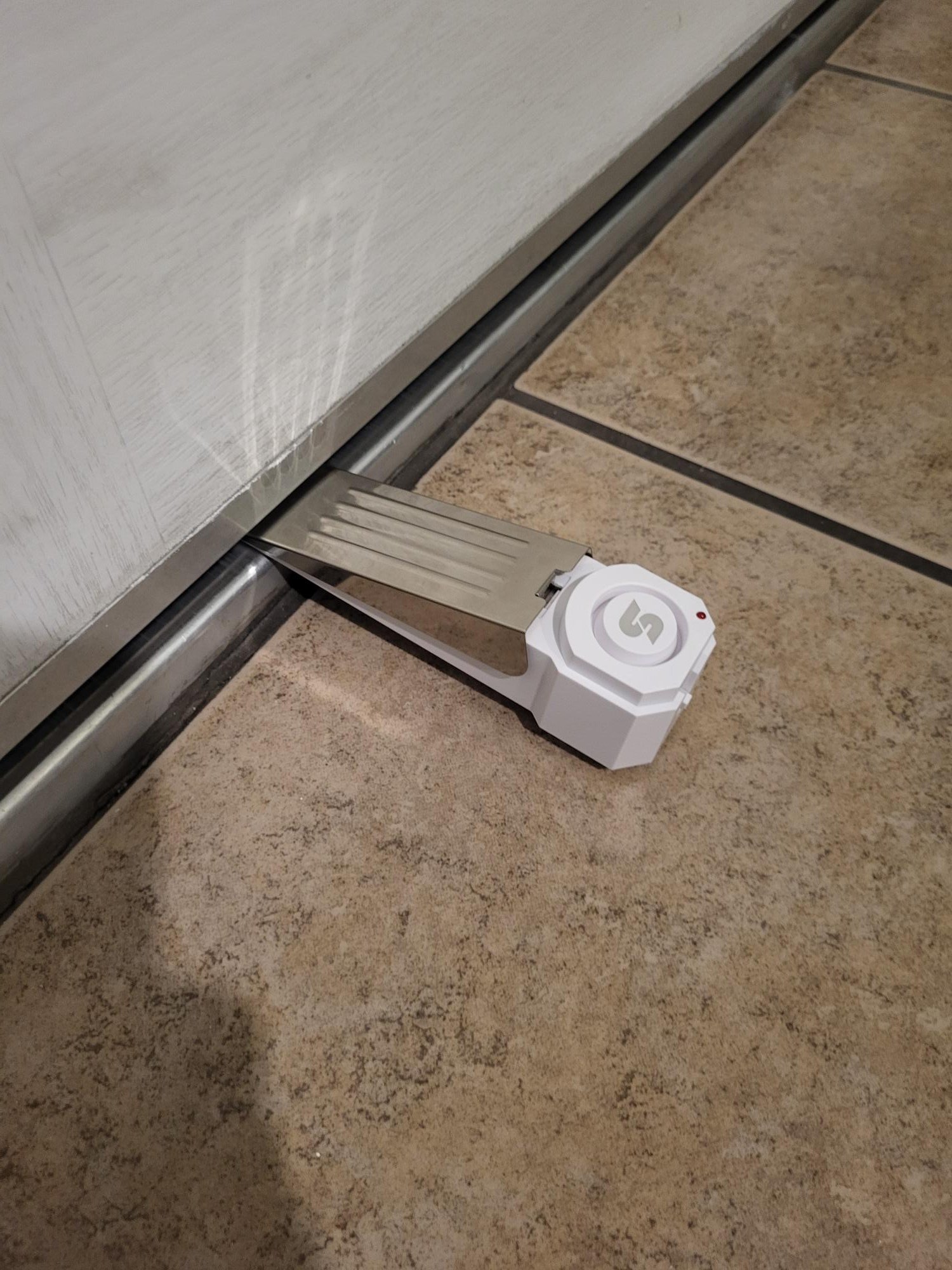
SABRE Wedge Door Stop Security Alarm
SABRE is a real security brand — the same company that makes professional-grade pepper spray. Their door stop alarm does two jobs at once: the non-skid wedge physically prevents the door from opening while the 120dB alarm screams if anyone tries. Audible up to 1,500 feet away. Battery operated, no wiring, fits in a jacket pocket. One important note: works best when there's a 7/8" gap or less between the floor and the bottom of the door — check your hotel room door when you arrive. At $9.79 it's one of the best value security items on this list.
- Stops door AND alarms
- SABRE — trusted brand
- 1,500 ft audible range
- Non-skid pad
- Needs 7/8" floor gap to work
- Only works from inside
- 9V battery not included
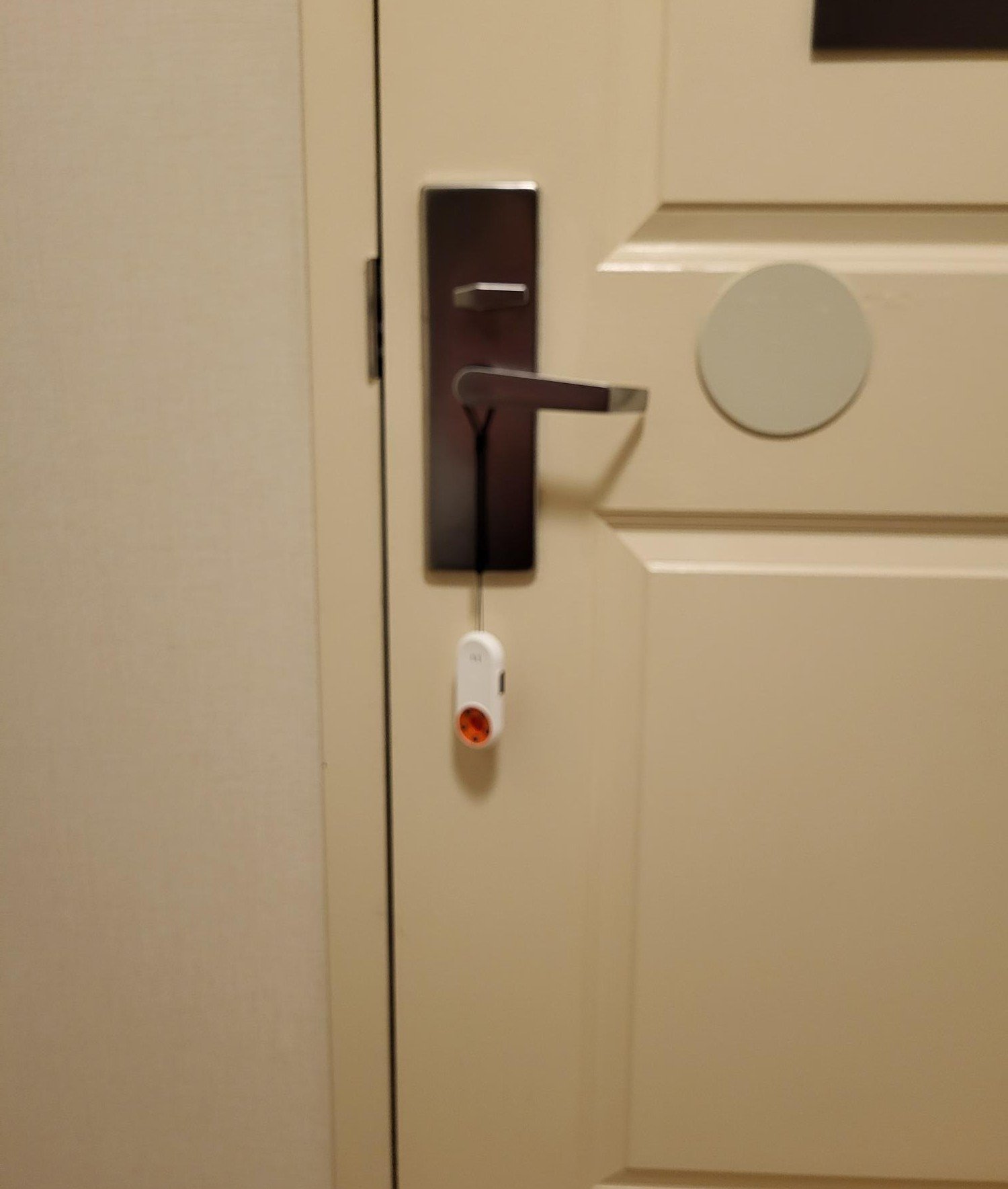
ANKOSHUN 3-in-1 Rechargeable Door Alarm
This one surprised me — it's three tools in one small device. Hang it from your hotel door handle and it vibrates and sounds a 130dB alarm if anyone touches or opens the door. But it also doubles as a personal SOS alarm (press the button for an ear-splitting siren and flashlight) and a hidden camera detector — use the red LED light to scan your room for reflective camera lenses in smoke detectors, clocks, or vents. At $22.99 and USB-C rechargeable, it's one of the best value-per-function items on this list. No batteries to worry about.
- 3 tools in 1 device
- USB-C rechargeable
- 130dB alarm — very loud
- Hidden camera detector built in
- Only 1hr continuous use
- Vibration alarm, not physical lock
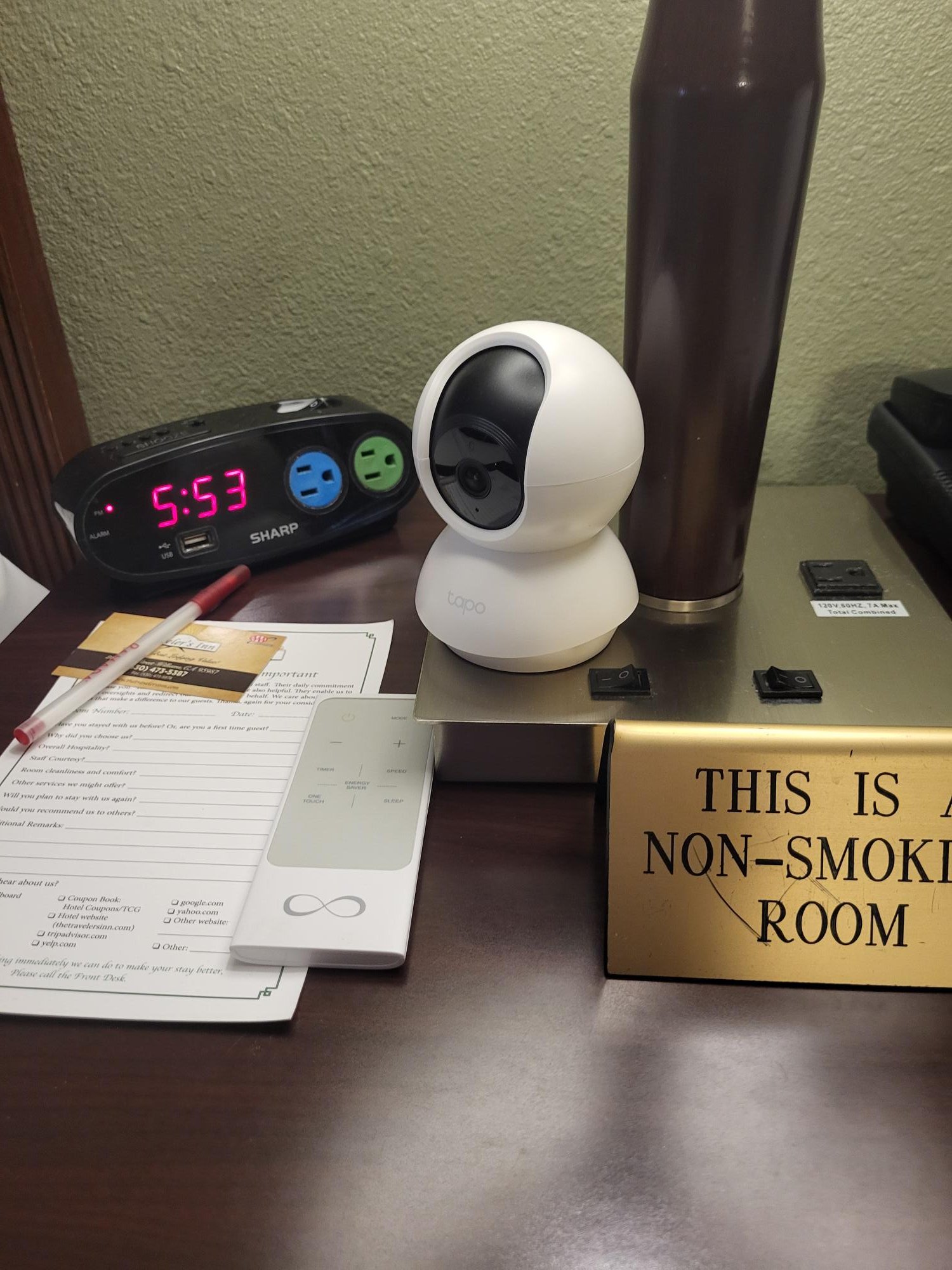
Tapo C210 2K Pan/Tilt Security Camera
Here's one most travel sites never mention: a small Wi-Fi camera pointed at your room door lets you see exactly who entered while you were out sightseeing. Did housekeeping go through your stuff? Did someone else come in? You'll know. The Tapo C210 sends instant motion alerts to your phone and streams live 2K video from anywhere. Set it up facing the door, connect to hotel WiFi, and go explore in peace. Pan/tilt means you can angle it to cover the entire room entry. USB rechargeable — no disposable batteries. Initial setup requires linking to your phone via the Tapo app. Note: if your hotel's WiFi blocks device connections, use your phone as a personal hotspot.
- Instant motion alerts
- 2K crystal clear video
- 360° pan/tilt coverage
- Works with Android & iPhone
- Needs WiFi or hotspot
- Setup takes a few minutes
- Some properties restrict use
Portable Safe or Locking Cable
When the room safe is too small, broken, or simply not there, a portable cable safe lets you secure your laptop, passport, and valuables to a fixed object like a bed frame or pipe. Heavy-duty wire cable inside a slash-resistant pouch. Not impenetrable, but it raises the effort required enough to deter most opportunistic theft. A locking cable alone works for securing bags to overhead racks on trains and overnight buses too.
- Works without a room safe
- Useful on trains too
- Slash-resistant options
- Determined theft still possible
- Heavier than other items
Portable Motion Sensor
A battery-powered motion sensor placed near a door or valuables will alert you if something moves while you're sleeping or away. Useful beyond hotel rooms — tents, campsites, hostel dorm rooms, and vacation rentals all become a little safer with a small sensor in the corner. Some models connect to your phone; others simply sound a local alarm. No installation, no wiring — just place and arm.
- Versatile — works anywhere
- No installation needed
- Some phone-connected
- Needs batteries
- False alerts possible
Theft Prevention
Pickpocketing, RFID skimming, bag snatching, and luggage theft are routine in high-tourist areas worldwide. These tools don't make you paranoid — they make you a harder target.
Travelon RFID Blocking Passport Cover
I carried an RFID-blocking passport cover for years — and this is the approach I recommend. Rather than a separate card you slip into an existing cover, the cover itself is the protection: RFID-blocking material is built into all sides, so your passport is shielded the moment it's inside. No partial coverage, nothing extra to remember. Modern e-passports contain a chip that can theoretically be scanned by anyone with the right equipment in a crowded airport or transit station. A cover like this stops that completely. Travelon is one of the most established names in travel security gear, carried by REI and widely available — and they have one of the more reliable affiliate programs in this category.
- Full coverage — all sides blocked
- All-in-one, nothing extra to buy
- Slim, fits any bag or pocket
- No batteries, no setup
- Passport only — pair with RFID wallet for cards
- Adds slight bulk to passport
Ekster RFID-Blocking Wallet
While Signal Vault protects your passport, Ekster handles your credit cards and ID. Their slim wallets use RFID-blocking material throughout, and some models include a built-in tracker card that connects to Apple's Find My network — so if your wallet is lost or stolen, you can track it. Ekster also makes a standalone Finder Card (credit-card sized) that slots into any existing wallet. The design is sleek enough that you won't feel like you're sacrificing style for security.
- RFID blocks all cards
- Optional built-in tracker
- Slim travel-friendly design
- Premium price point
- Tracker needs phone nearby
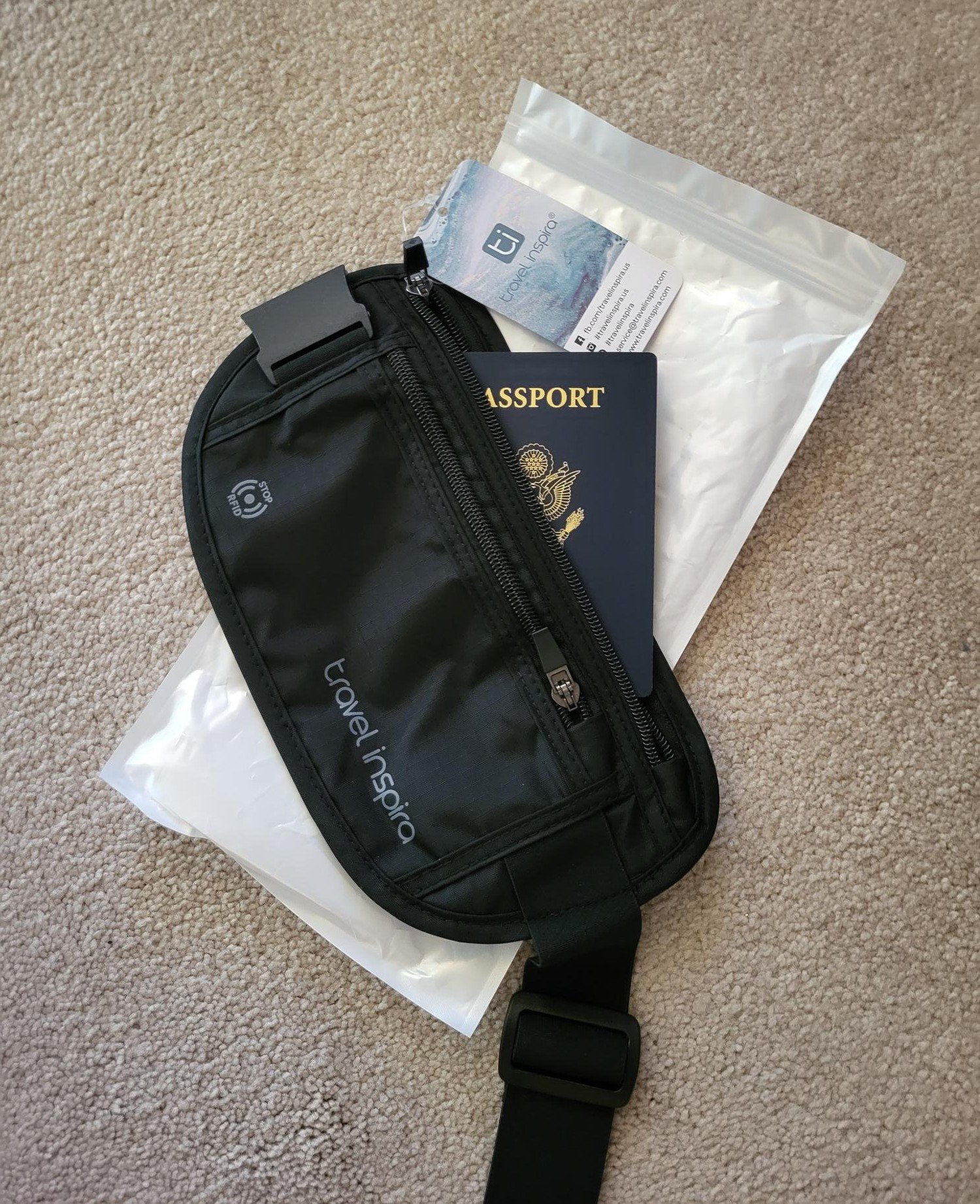
Travel Inspira RFID Blocking Money Belt
In high-pickpocket areas — Barcelona's Las Ramblas, Rome's Colosseum, Bangkok's markets — your front pocket is still visible to skilled thieves. This Travel Inspira money belt wears flat under clothing, keeping your backup cash, passport copy, and secondary card completely out of reach. RFID blocking protects your cards from electronic skimming too. The anti-theft zipper requires a specific upward pull to open — making it nearly impossible for anyone but you to access. Waterproof, adjustable up to 55" waist, and slim enough to wear under a t-shirt without a visible bulge. Use it for backup only — keep daily-use cash in a pocket so you're not digging under your shirt at every café.
- RFID blocking built in
- Anti-theft zipper
- Waterproof
- Hidden under clothing
- Awkward to access in public
- Can be uncomfortable in heat
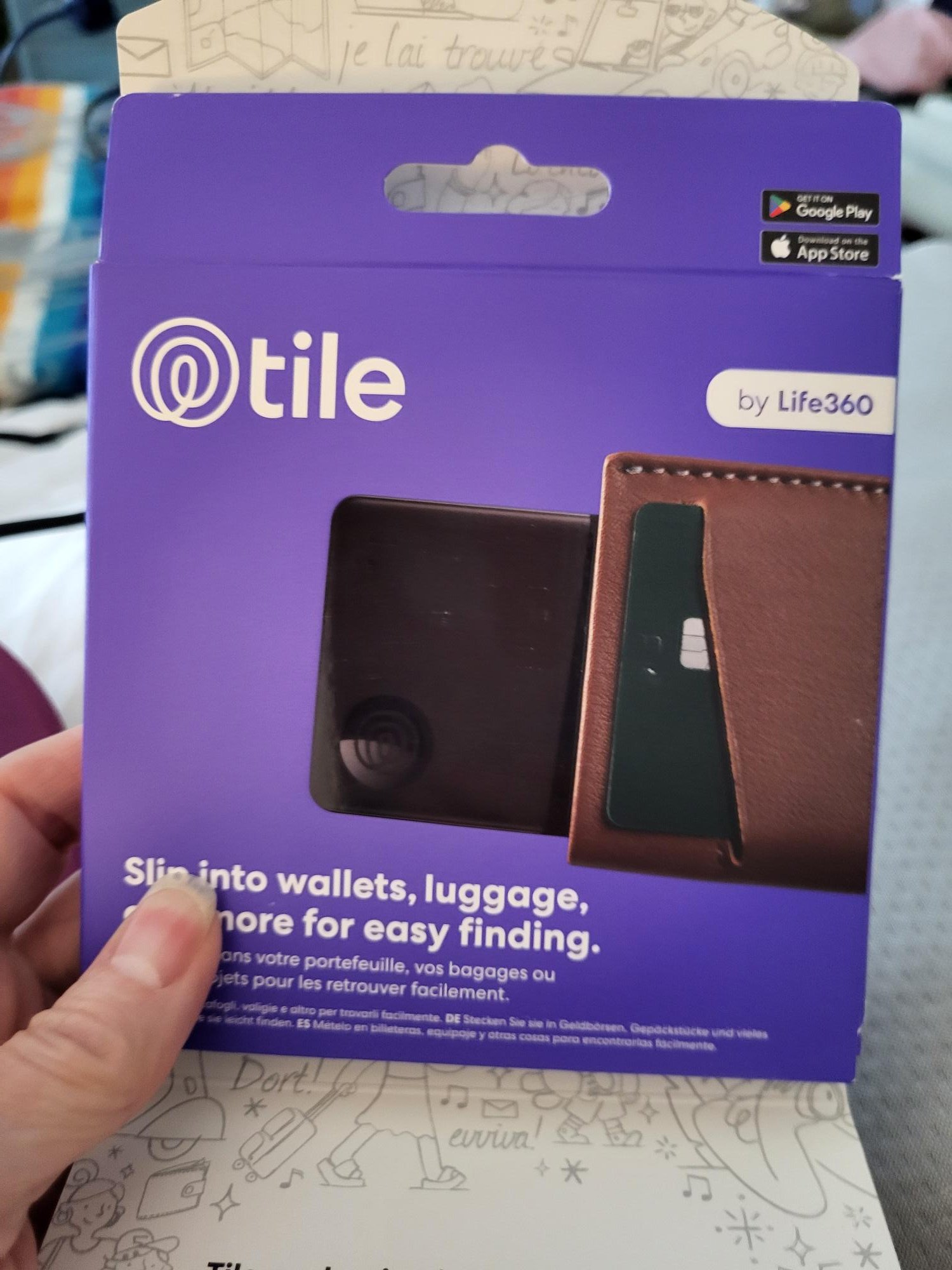
Luggage Trackers
Forge TSA Approved Luggage Locks — 4 Pack
The #1 Best Seller in luggage locks for good reason. Forge's TSA-approved cable locks let airport security open your bag without cutting the lock — and the "Open Alert" indicator tells you if TSA actually did open your bag while you were away. Resettable combination, flexible cable, zinc alloy body. At $5.38 per lock the 4-pack gives you one for each bag, one for your backpack, and a spare. Simple, reliable, and one of the best value travel security purchases you can make.
- TSA approved
- Open Alert tells you if opened
- 4-pack great value
- Resettable combination
- Not slash-proof
- Combination can be forgotten
Power & Connectivity
A dead phone in an unfamiliar city is more than an inconvenience — it's a safety issue. Staying powered and connected isn't a luxury, it's infrastructure.
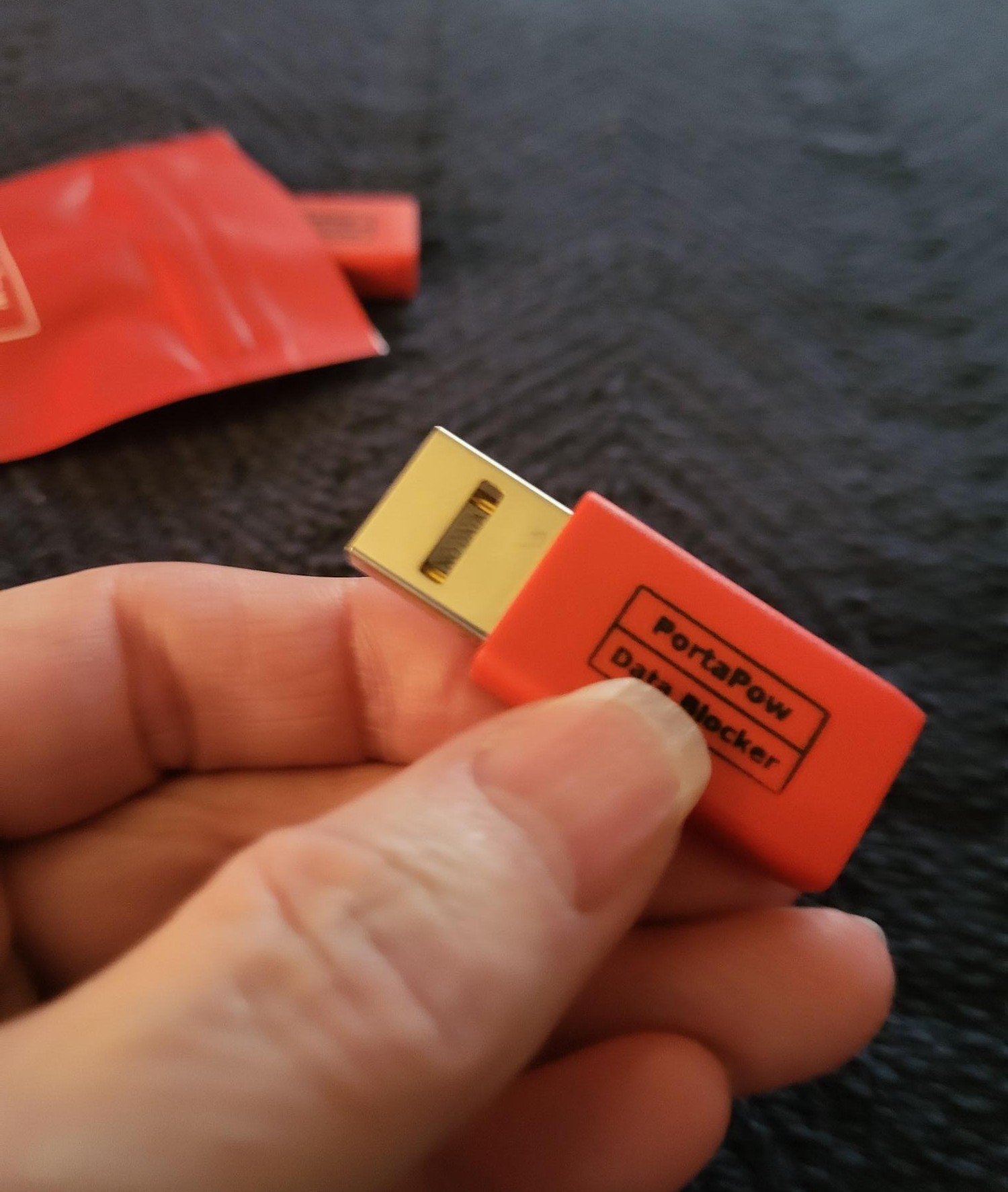
PortaPow USB-A to USB-C Data Blocker — 2 Pack
Most travelers have never heard of juice jacking. Here's what it is: public USB charging ports — at airports, hotels, coffee shops, and rental cars — can be rigged to transfer data to and from your device while it charges. You plug in to get power and someone else gets access to your phone. A USB data blocker sits between your cable and the charging port and physically removes the data pins. Power gets through. Data doesn't. This version is specifically for Android and modern iPhone users with USB-C cables — plug into any public USB-A port and your USB-C phone charges safely. PortaPow is the original and most trusted brand in this category. The 2-pack means one for your bag and one as a backup. Note: this covers public USB-A ports. If the public port itself is USB-C, you'd need the USB-C to USB-C version.
- Physically blocks data — not software
- Perfect for USB-C phones
- Works at any public USB-A port
- Trusted brand, 4.5 stars
- Won't work on USB-C public ports
- Easy to lose — keep it clipped to your cable
Power Banks
Universal Travel Adapter
Outlet standards vary by country and sometimes by region within a country. A quality universal adapter covers Type A, B, C, G, and I plugs — meaning virtually everywhere you'll travel. Look for one with built-in USB-A and USB-C ports so you can charge multiple devices simultaneously without bringing a power strip. Not all adapters handle high-wattage devices like hair dryers — check the wattage rating before using anything with a heating element.
- Works in 150+ countries
- USB ports built in
- One item, all plugs
- Bulkier than single-country adapters
- Not a voltage converter
Portable Wi-Fi Hotspot
Hotel Wi-Fi is slow, unsecured, and sometimes unavailable. A dedicated travel hotspot — either a pocket device with a local SIM or a global eSIM plan — gives you your own secure connection wherever you are. For digital nomads, this is non-negotiable. For any traveler, it means Google Maps works when you need it most. Options range from renting a device to buying a global SIM that works in 100+ countries. Compare plans before your trip — pricing varies widely.
- Secure private connection
- Share with travel companions
- Works where hotel Wi-Fi fails
- Another device to charge
- Monthly/daily data costs
Health & Emergency Preparedness
Getting sick or injured abroad is stressful enough. Not being prepared makes it worse. These items don't replace travel insurance or medical care — they bridge the gap until you can get it.
Travel First Aid Kits
Customize Your Kit: What Experienced Travelers Actually Carry
Most off-the-shelf kits cover the basics but miss what travelers actually need. Here's how to fill the gaps:
Water Purification
Compact Flashlight or Headlamp
Power outages happen everywhere. Finding your way to the emergency exit of a hotel during a blackout, navigating a dark stairwell, arriving at a guesthouse after midnight — a small flashlight handles all of it. A headlamp is more versatile since it keeps your hands free. Black Diamond makes the gold standard in travel-weight headlamps, but any quality LED flashlight is better than relying on your phone battery for light.
- Hands-free if headlamp
- Works without a phone
- Long battery life
- Needs batteries or charging
- Easily forgotten at home
Emergency Whistle
A quality emergency whistle produces 100–120 decibels — far louder than a human scream and audible over significant distance and background noise. Attach it to your bag zipper or keychain and forget it's there. If you're ever in an emergency situation — trapped, injured, needing immediate attention — a whistle carries farther than your voice and doesn't exhaust you. Weighs almost nothing and costs almost nothing. There's no reason not to carry one.
- Extremely loud signal
- Weightless, priceless
- No batteries required
- Situational — not everyday use
Emergency Contact & Medical Info Card
If you're ever unconscious, disoriented, or unable to communicate, a laminated card in your wallet or bag tells first responders everything they need to know: your name, blood type, allergies, medications, emergency contacts, and travel insurance details. You can print a template for free and laminate it for a few dollars. This is not a product you buy — it's a habit you form. We include a free printable template in our resources section.
- Could save your life
- Free to create yourself
- Works when your phone doesn't
- Must keep it updated
- Language barriers in some countries
Solo Traveler Essentials
Solo travel is one of the most rewarding experiences you can have. It also means you're your own backup plan. These items are especially valuable when you're moving through the world alone.
Personal Safety Alarm
A personal safety alarm is a small device — often keychain-sized — that emits a piercing 120+ decibel alarm when activated. Pull a pin or press a button and it screams. The sound is disorienting, attention-grabbing, and creates immediate public awareness of a situation. It's legal to carry virtually everywhere (unlike pepper spray, which has restrictions), doesn't require physical confrontation, and can be used to signal distress in non-threat situations too — injury, medical emergency, getting lost.
- Legal almost everywhere
- No training needed
- Draws immediate attention
- Keychain size
- Needs battery
- Must be accessible to work
Peephole Cover Tape
Most travelers don't realize that a peephole works both ways. Reverse peephole viewers — available cheaply online — let anyone in the hallway see into your room. A small piece of opaque tape over the inside of the peephole eliminates that vulnerability completely. It costs pennies, weighs nothing, and takes three seconds to apply. This is one of those "you can't unsee it once you know" travel security habits.
- Costs almost nothing
- Weighs almost nothing
- Instant privacy
- Blocks your own view out
- Must remember to remove it